
You know your parents need to exercise. They probably know it too.
Getting them actually to do it is a different problem entirely.
I know this personally. My own mother took 3 months of convincing. I am a certified trainer working with older adults every day and it still took me 3 months.
This is the guide I wish I had when I first tried asking.
Why Strength Matters More Than You Think
Before your conversation, understand what is at stake.
What happens with muscle loss | What it means for your family |
|---|---|
Falls and hip fractures | Emergency leave, hospitalisation, months of recovery |
Insulin resistance and diabetes | More specialist visits, medication and unpaid leave |
Loss of parents' independence | Increased caregiver costs and making assisted living decisions |
Cognitive decline | Faster functional deterioration increase burden of care |
Muscle loss begins in your 30s and by 70, the average person has lost so much muscle that getting out of bed in the morning is the first physical challenge of the day.
The condition is called sarcopenia and in the Yishun Study, Singapore's first population-representative research, found that 1 in 3 Singaporeans over 60 already has it.
None of this is inevitable. Resistance training is the most effective intervention toreverse muscle loss at any age.
What Not to Do
Most adult children like me once make the same mistakes. Avoid these
What to avoid | Why it backfires |
|---|---|
Lead with fear ("you might fall") | Creates defensiveness and not motivation |
Comment on their appearance or frailty | Rarely received the way it's intended |
Give unsolicited advice | Positions you as a critic and not a supporter |
Compare them to others ("Uncle Davin gyms every day") | Comparison feels like pressure, not inspiration |
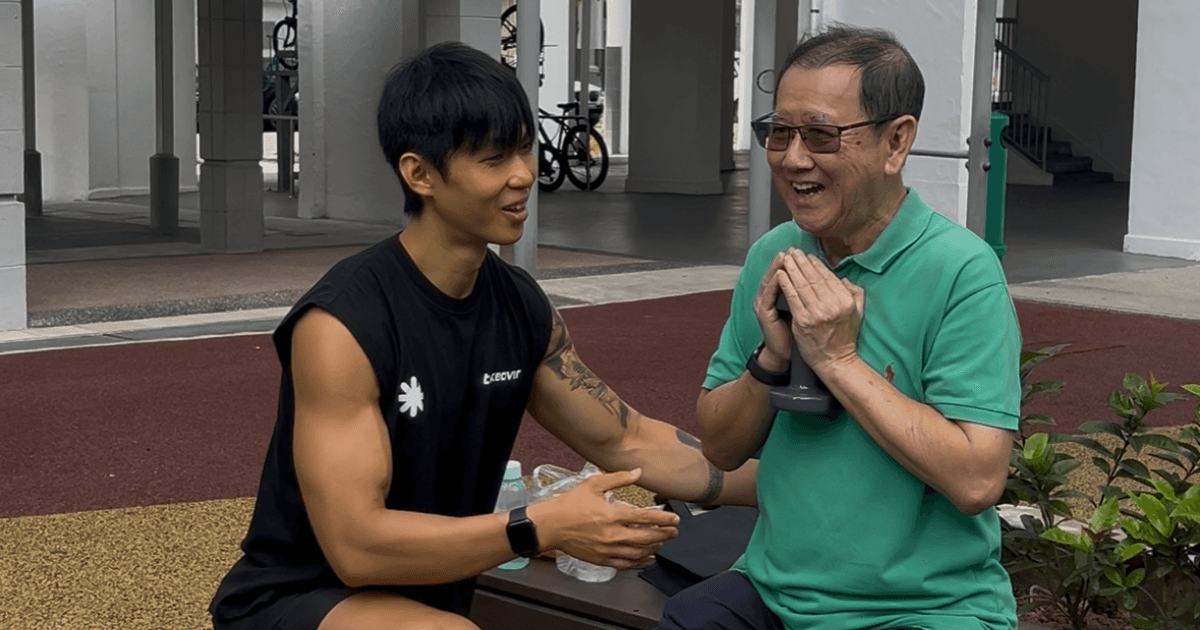
What Actually Works
1. Start with curiosity, not instruction
Ask what their body feels like. Are stairs harder? Do they feel less balanced? Is there something they used to do easily that now takes effort? A parent who identifies a problem themselves is far more receptive than one being told they have one.
2. Connect it to what they already value
Independence is a stronger motivator than health in the abstract. Link exercise to what matters to them specifically.
What your parent values | What to say |
|---|---|
Travelling | "I want you to be able to carry your own bag when we go." |
Grandchildren | "I want you to be able to get down on the floor and play with them." |
Not being a burden | "This is how we make sure you stay in charge of your own life." |
Living alone | "This is how you stay in this house." |
3. Lower the commitment to one session
"You should start exercising" is too vague to act on.
"Would you come with me once, just to try it out?" has a clear endpoint. Most people who try one session find it far less daunting and more enjoyable than they expected.
4. Make it social
Older adults are significantly more likely to continue exercising when another person like their partner or children is involved. Come along for the first session. Your participation signals they matters to you.
How to Handle the Common Objections
What they say | What it actually means | What to say back |
|---|---|---|
"I'm too old for that." | Fear of looking incapable | Adults in their 70s and 80s with no training history have made meaningful gains. Age is the reason to start, not the reason to wait. |
"I have bad knees / a bad back." | Fear of making pain worse | Those are reasons to train with a qualified professional, not reasons to avoid it. The exercise is built around them. |
"I already walk every day." | Genuine belief that walking is enough | Walking is great for cardiovascular health but It does not build muscle. They do different things. |
"The gym is not for me." | Picturing a commercial, busy gym environment | One-to-one exercise is private, and looks nothing like a commercial gym. Home-visits are available too. |
If the Conversation Keeps Failing
Some parents are not ready and that's okay.
What you can do now:
Find a practitioner you trust before you need one
Know what a first session looks like so you can describe it accurately
Have a concrete next step ready: a name or a number in case when a fall happens or a moment of reflection opens the door of opportunity
The most common thing adult children say after a parent starts strength training is that they wished they had started sooner. The second most common is that the elderly can't believe they waited so long.
Is This Guide Useful? Share It!
If you have a friend or a colleague going through the same conversation, send them this. The more prepared the conversation, the more likely it lands.
Book a free consultation for your parent →
You know your parents need to exercise. They probably know it too.
Getting them actually to do it is a different problem entirely.
I know this personally. My own mother took 3 months of convincing. I am a certified trainer working with older adults every day and it still took me 3 months.
This is the guide I wish I had when I first tried asking.
Why Strength Matters More Than You Think
Before your conversation, understand what is at stake.
What happens with muscle loss | What it means for your family |
|---|---|
Falls and hip fractures | Emergency leave, hospitalisation, months of recovery |
Insulin resistance and diabetes | More specialist visits, medication and unpaid leave |
Loss of parents' independence | Increased caregiver costs and making assisted living decisions |
Cognitive decline | Faster functional deterioration increase burden of care |
Muscle loss begins in your 30s and by 70, the average person has lost so much muscle that getting out of bed in the morning is the first physical challenge of the day.
The condition is called sarcopenia and in the Yishun Study, Singapore's first population-representative research, found that 1 in 3 Singaporeans over 60 already has it.
None of this is inevitable. Resistance training is the most effective intervention toreverse muscle loss at any age.
What Not to Do
Most adult children like me once make the same mistakes. Avoid these
What to avoid | Why it backfires |
|---|---|
Lead with fear ("you might fall") | Creates defensiveness and not motivation |
Comment on their appearance or frailty | Rarely received the way it's intended |
Give unsolicited advice | Positions you as a critic and not a supporter |
Compare them to others ("Uncle Davin gyms every day") | Comparison feels like pressure, not inspiration |
What Actually Works
1. Start with curiosity, not instruction
Ask what their body feels like. Are stairs harder? Do they feel less balanced? Is there something they used to do easily that now takes effort? A parent who identifies a problem themselves is far more receptive than one being told they have one.
2. Connect it to what they already value
Independence is a stronger motivator than health in the abstract. Link exercise to what matters to them specifically.
What your parent values | What to say |
|---|---|
Travelling | "I want you to be able to carry your own bag when we go." |
Grandchildren | "I want you to be able to get down on the floor and play with them." |
Not being a burden | "This is how we make sure you stay in charge of your own life." |
Living alone | "This is how you stay in this house." |
3. Lower the commitment to one session
"You should start exercising" is too vague to act on.
"Would you come with me once, just to try it out?" has a clear endpoint. Most people who try one session find it far less daunting and more enjoyable than they expected.
4. Make it social
Older adults are significantly more likely to continue exercising when another person like their partner or children is involved. Come along for the first session. Your participation signals they matters to you.
How to Handle the Common Objections
What they say | What it actually means | What to say back |
|---|---|---|
"I'm too old for that." | Fear of looking incapable | Adults in their 70s and 80s with no training history have made meaningful gains. Age is the reason to start, not the reason to wait. |
"I have bad knees / a bad back." | Fear of making pain worse | Those are reasons to train with a qualified professional, not reasons to avoid it. The exercise is built around them. |
"I already walk every day." | Genuine belief that walking is enough | Walking is great for cardiovascular health but It does not build muscle. They do different things. |
"The gym is not for me." | Picturing a commercial, busy gym environment | One-to-one exercise is private, and looks nothing like a commercial gym. Home-visits are available too. |
If the Conversation Keeps Failing
Some parents are not ready and that's okay.
What you can do now:
Find a practitioner you trust before you need one
Know what a first session looks like so you can describe it accurately
Have a concrete next step ready: a name or a number in case when a fall happens or a moment of reflection opens the door of opportunity
The most common thing adult children say after a parent starts strength training is that they wished they had started sooner. The second most common is that the elderly can't believe they waited so long.
Is This Guide Useful? Share It!
If you have a friend or a colleague going through the same conversation, send them this. The more prepared the conversation, the more likely it lands.
Book a free consultation for your parent →
Davin Choo is an ACE-Certified Personal Trainer and ACSM Exercise is Medicine practitioner based in Singapore, specialising in clinical exercise for active ageing, sarcopenia, and chronic disease management.
FAQ
Answers to your questions
Get quick, clear information about our services, appointments, support, and more
🏠 Do you do home visits for elderly clients?
⏰ How long does a session take?
🏥 What conditions do you work with?
📊 What kind of results can I expect?
🏷️ How much do sessions cost?
🚀 How do I get started?
FAQ
Answers to your questions
Get quick, clear information about our services, appointments, support, and more
🏠 Do you do home visits for elderly clients?
⏰ How long does a session take?
🏥 What conditions do you work with?
📊 What kind of results can I expect?
🏷️ How much do sessions cost?
🚀 How do I get started?
FAQ
Answers to your questions
Get quick, clear information about our services, appointments, support, and more
🏠 Do you do home visits for elderly clients?
⏰ How long does a session take?
🏥 What conditions do you work with?
📊 What kind of results can I expect?
🏷️ How much do sessions cost?
🚀 How do I get started?